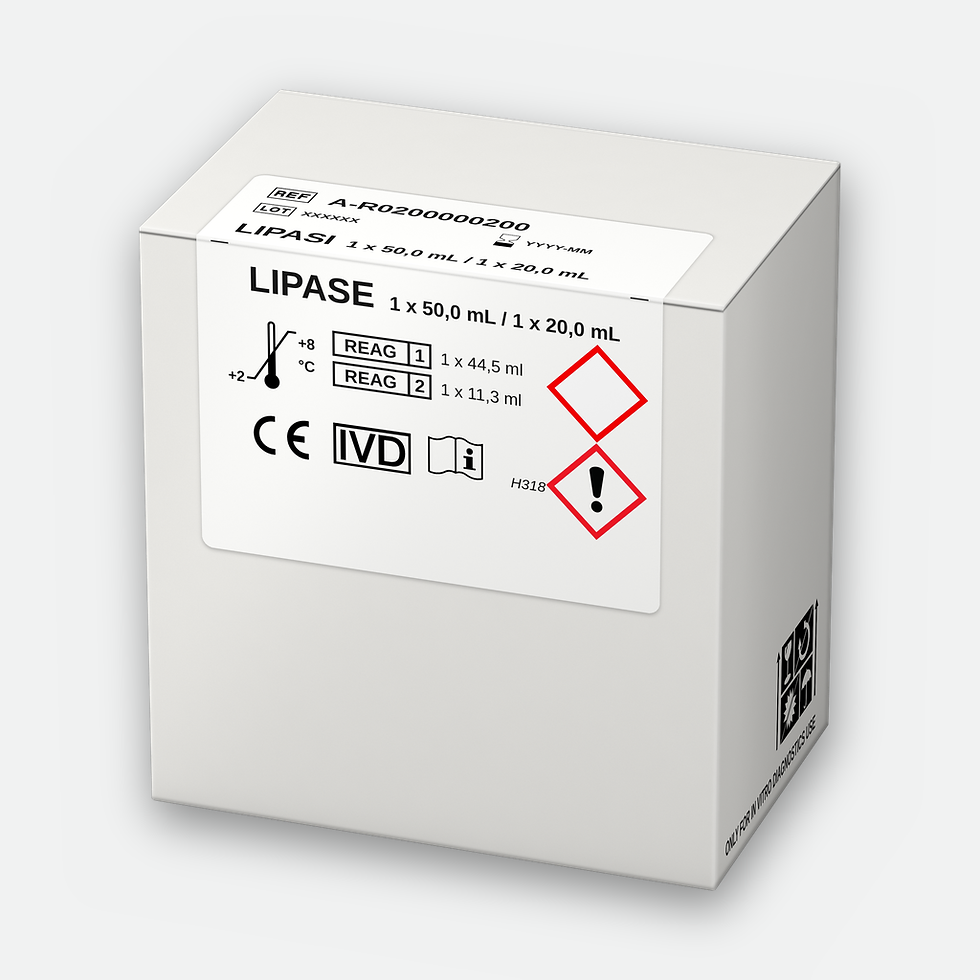
Magnesium
Product for use in the quantitative determination in vitro of the concentration of Magnesium in human serum, plasma and urine. The results of the test must always be interpreted in conjunction with the clinical picture.
Tests per Kit
912
Test Category
Minerals & Trace Elements
Target Analytes
Magnesium
Sample Type
Non-haemolysed human serum samples or plasma
Kit Components
Reagent: 4 x 50 mL,
Ready for useTech Docs
Instructions for Use | Safety Data Sheet
Intended Use
For professional use only.
Clinical Significance
About 55% of the total magnesium present in the human body is found in the bone, while the remaining portion is within the cells, bound to proteins or molecules with a negative charge. About 55% of the magnesium present in the serum is free, 30% is bound to proteins and 15% is in the form of compounds bound to phosphate or citrate ions. It is of fundamental importance in oxidative phosphorylation, in glycolysis and in cellular replication. The reference method for the determination of magnesium in serum and urine makes use of atomic absorption spectrophotometry. For routine diagnostic use, colorimetric assay methods have been developed based on compounding reactions between colouring substances (calmagite, methylthymol blue, titanium yellow, non-sulphonated derivatives of xylidyl-blue, xylidyl-blue). The reagent makes use of xylidyl blue which is more sensitive than other stains. Like the other colouring substances, it also compounds cations other than magnesium, and in particular calcium, and it must therefore be associated with a chelating agent which eliminates this type of interference (1.2).
Test Principle
Xylidyl-blue forms a soluble coloured compound with magnesium in an alkaline ambient, with a maximum absorbance between 505 and 520 nm. The intensity of the colour of the Mg-xylidyl-blue compound is directly correlated to the magnesium concentration in the sample. Calcium interference is eliminated by including a specific chelator in the reagent: diethylene-glycol bis (2-amino-ethylether) N,N-N',N'-tetracetic acid (EDTA).
Stability & Storage
Store at 2 - 8°C and protect from direct light. When correctly stored, the reagents are stable up the expiry date reported on the label. A slight variation in the composition of the reagent may occur between batches, but this has no effect on the test results. After opening, the vial are stable 30 days if recapped immediately and protected from contamination, evaporation, direct light and stored at correct temperature.
Required but Not Supplied
Multicalibrator (R0300000006)
Normal control serum (R0400000006)
Pathological control serum (R0400000106)