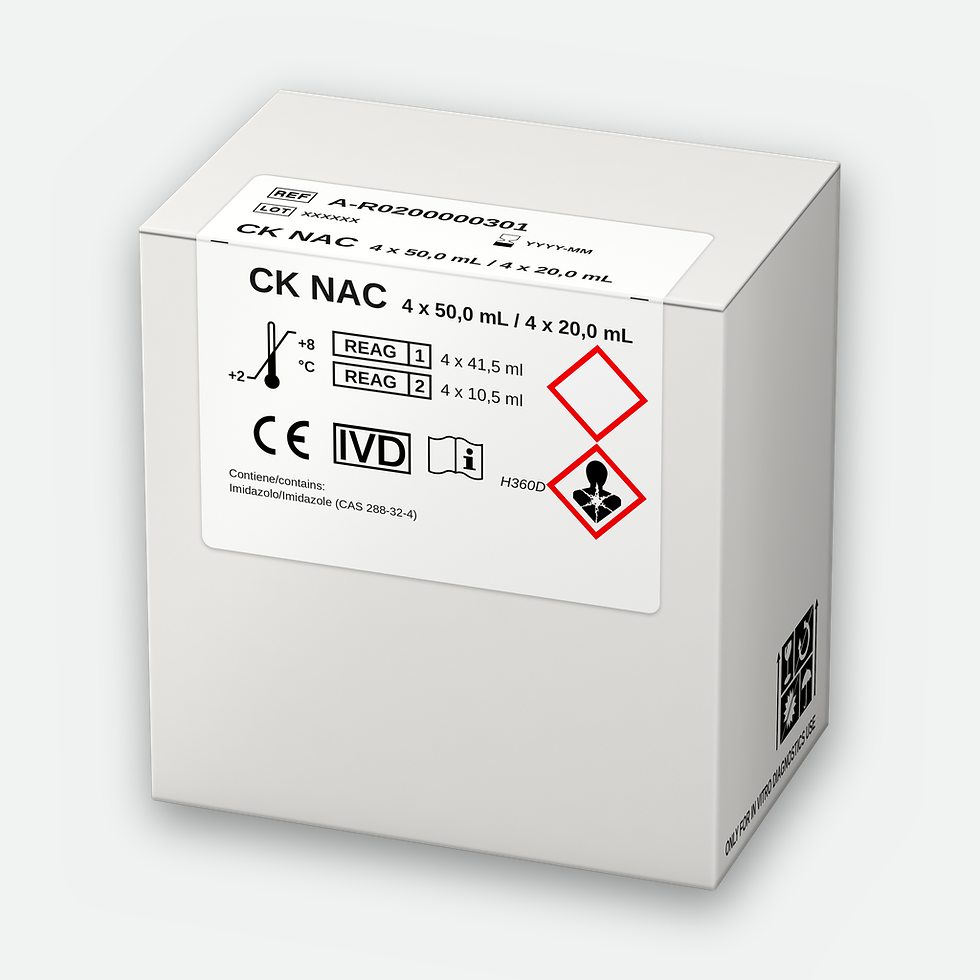
Direct Bilirubin
Product for use in the quantitative determination in vitro of the concentration of the Direct Bilirubin in human serum or plasma. The results of the test must always be interpreted in conjunction with the clinical context.
Tests per Kit
920
Test Category
Substrates & Metabolites
Target Analytes
Direct bilirubin
Sample Type
Fresh, non-haemolysed serum or plasma
Kit Components
R1: 4 x 46 mL;
R2: 4 x 12 mL,
Ready to useTech Docs
Instructions for Use | Safety Data Sheet
Intended Use
For professional use only.
Clinical Significance
Approximately 80-85 % of the bilirubin produced is derived from the heme moiety of the haemoglobin released from aging erythrocytes in the reticuloendothelial cells. Bilirubin, bound to albumin, is transported into the liver where it is rapidly conjugated with glucuronide to increase its solubility. Then it is excreted into biliary canaliculi, and hydrolysed in the gastrointestinal tract. Unconjugated bilirubin serum concentration increases in case of overproduction of bilirubin (acute or chronic haemolytic aniemias) and in case of disorders of bilirubin metabolism and transport defects (impaired uptake by liver cells: Gilbert’s syndrome; defects in the conjucation reaction: Crigler-Najjar syndrome). Reduced excretion (hepatocellular damage: hepatitis, cirrhosis, Dubin-Johnson and Rotor syndrome) and obstruction to the flow of bile (most often produced by gallstones or by tumours) induce an important elevation of conjugated bilirubin and in a minor extent an increase of unconjugated bilirubin (conjugated hyperbilirubinemia).
Test Principle
Mally – Evelyn modified. End point. Sulfanilic acid reacts with sodium nitrite to form diazotised sulfanilic acid. In the presence of accelerator (centrimide), conjugated and unconjugated bilirubin react with diazotised sulfanilic acid to form azobiliburin (Bilirubin Total 4+1). In the absence of accelerator, only conjugated bilirubin reacts (Bilirubin direct 4+1). The increase of absorbance at 550 nm is proportional to bilirubin concentration.
Sulfanilic acid + NaNO2 → Diazotised sulfanilic acid
Bilirubine + Diazotised sulfanilic acid → AzobilirubinStability & Storage
Store at 2-8°C and protect from direct light. When correctly stored, the reagents are stable up the expiry date reported on the label. A slight variation in the colour of the reagent may occur between batches, but this has no effect on the test results. After opening, the vial R1 and R2 are stable 28 days if recapped immediately and protected from contamination, evaporation, direct light and stored at correct temperature
Required but Not Supplied
Multicalibrator (R0300000006)
Normal control serum (R0400000006)
Pathological control serum (R0400000106)