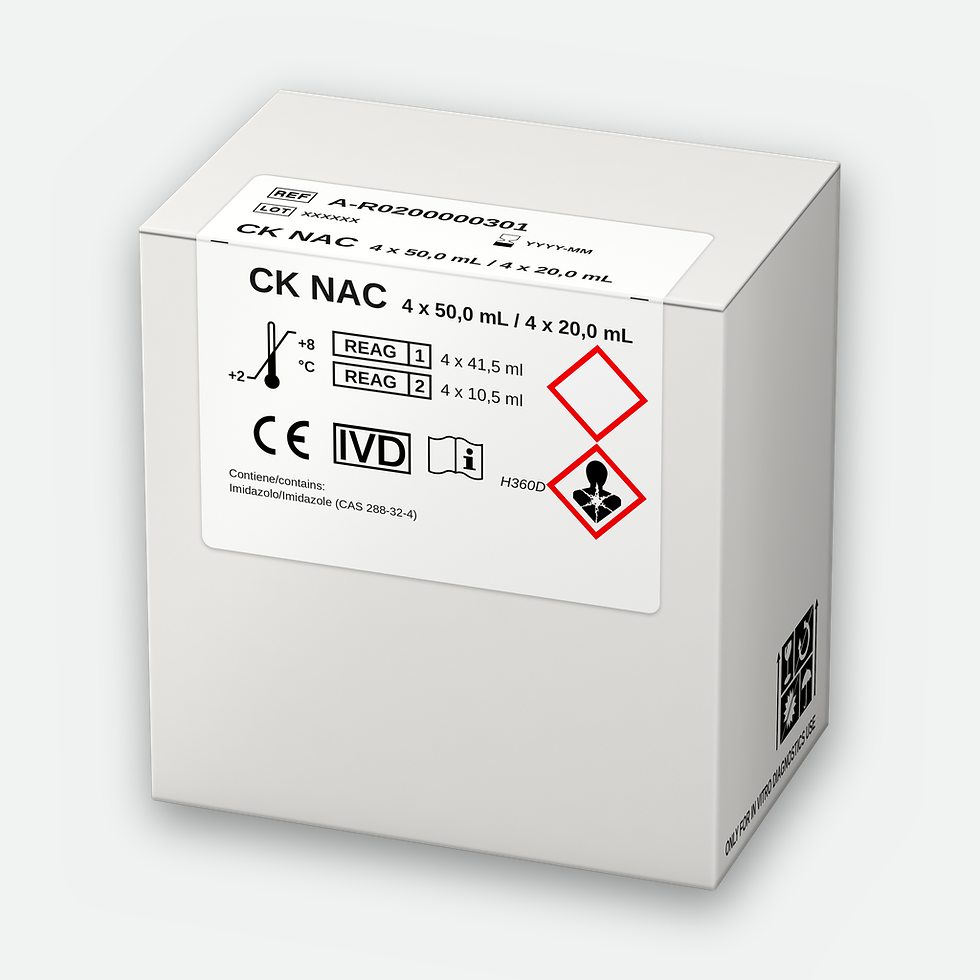
CK-NAC
Product used for the quantitative invitro determination of creatinkinase (CK) in human serum and plasma. The test results should always be interpreted with reference to the clinical picture.
Tests per Kit
927
Test Category
Enzymes
Target Analytes
Creatine kinase (CK)
Sample Type
Serum or plasma containing heparin
Kit Components
R1: 4 x 41.5 mL;
R2: 4 x 10.5 mL,
Ready to useTech Docs
Instructions for Use | Safety Data Sheet
Intended Use
For professional use only.
Clinical Significance
Creatine kinase exists in 3 cytoplasmic forms: CK-MB (in cardiac muscle only), CK-MM (in striated and cardiac muscle) and CK BB (especially in brain). Determination of CK in serum is used for the diagnosis and the follow-up of cardiac muscle damages. In myocardial infarction, the rates of total CK and CK-MB increase quickly until reaching a peak 10-24h after the onset of the infarction. The levels return to normal within 3 to 4 days. CK-MB levels higher than normal can also be observed after muscle damages.
Test Principle
IFCC method - kinetics. Creatine kinase catalyses the reaction between creatine phosphate and ADP with the formation of creatine and ATP. The ATP formed, in the presence of glucose and hexokinase (HK), gives ADP and glucose 6-phosphate. Glucose-6phosphate formed in the presence of glucose 6-phosphate dehydrogenase (G6P-DH), reacts with the formation of ß-NADP+6-phosphogluconate and ß-NADPH. The increase in absorbance due to the ß-NADP+---> ß-NADPH reaction is proportional to the CK activity in the sample. The presence of N-acetyl-L-cysteine (Nac) in the reaction mixture allows optimal activation of the CK enzyme.
Creatine Phosphate + ADP --(Creatine Kinase)--> Creatine + ATP
ATP + D-Glucose --(Hexokinase)--> D-Glucose-6- Phosphate + ADP
G-6-P + NADP+ --(G-6-PDH)--> D-Gluconate-6- Phosphate + NADP + H+
G-6-P: D-Glucose-6-Phosphate
G-6-PDH: Glucose-6-Phosphate Dehydrogenase.
The rate of increase in NADPH concentration measured at 340 nm is directly proportional to the enzymatic activity of CK.Stability & Storage
Store at 2 - 8°C and protect from direct light. When correctly stored, the reagents are stable up to the expiry date reported on the label. A slight variation in the composition of the reagents may occur between batches, but this has no effect on the test results. The reagents are liquid, ready to use. The solutions must be limpid with no evident precipitate. Pay attention to avoid bacterial contamination during use. The stability of the reagents are 30 days if closed, stored at 2 - 8°C and protect from direct light. Preparation: mix 4 volumes of Reagent R1 with 1 volume of Reagent R2. The working reagent is stable 7 days if stored refrigerated. Do not use the product if there is physical evidence of deterioration (ex. particle matter)
Required but Not Supplied
Multicalibrator (R0300000006)
Normal control serum (R0400000006)
Pathological control serum (R0400000106)